

Australian Restaurant Surcharges: Check Before You Order
Table of contents
- Quick answer
- Separate the surcharge types
- Check card-payment surcharges
- Understand cashless pricing
- Read weekend and public-holiday notices
- Check before booking or joining a queue
- Confirm before ordering
- Review the bill calmly
- Watch the 2026 card-rule transition
- Surcharge checklist
- Limitations
- Frequently asked questions
- Sources and evidence notes
- Conclusion
Quick answer
Before ordering at an Australian restaurant or café, check the menu, booking page, ordering app, and counter for card, weekend, public-holiday, service, or group fees. Ask which payment method avoids a card surcharge, if any, and whether multiple surcharges can apply together. Keep the advertised price and receipt. Current Australian rules treat card surcharges differently from weekend and public-holiday charges, and card-network rules may change from 1 October 2026.

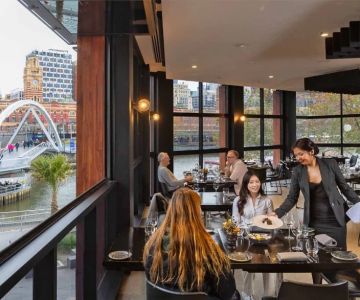
Vic On George
SydneyCouncil of the City of SydneyNew South Wales
Level 3, Myer, 450 George St, Sydney NSW 2000, Australia
Separate the surcharge types
A card-payment surcharge is linked to how you pay. A weekend or public-holiday surcharge is linked to when the meal is supplied. Other fees may relate to large groups, cake service, booking platforms, table service, delivery, or minimum spend. They should not be blurred into one unexplained line.
Ask whether percentages are calculated on menu items only or also on other fees, and whether more than one charge applies. GST should already be reflected in consumer prices where required; a surcharge is not automatically a tax. Clear classification makes it easier to compare restaurants and check the bill.

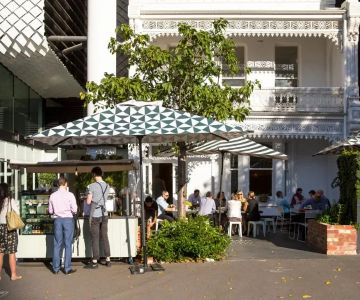
Dymocks Cafe
SydneyCouncil of the City of SydneyNew South Wales
Mezzanine Level, 428 George St, Sydney NSW 2000, Australia
Check card-payment surcharges
Under the current ACCC guidance, businesses can generally surcharge credit, debit, and prepaid card payments, but the charge must not be more than the business's cost of accepting that payment type. Different card types can have different costs, so “card surcharge” may not be a single percentage.
The surcharge should be clear before you book, order, or pay. Look for a notice on the menu, point-of-sale terminal, ordering app, or counter. Before tapping, ask the employee to identify the surcharge for the card you plan to use. Selecting “credit” or using a mobile wallet can route a payment differently; the business or terminal should explain available options.
Understand cashless pricing
If every available payment method attracts a surcharge, the minimum unavoidable surcharge generally must be included in the displayed product price. For example, a cashless venue that surcharges all cards cannot rely only on a lower menu price that no customer can actually pay.
If a surcharge-free option exists, it should be practical and disclosed. Ask whether cash, EFTPOS savings, bank transfer, or another method is accepted before ordering, but do not assume any particular business must accept cash. Compare the final payable amount, not the headline menu price alone.
Read weekend and public-holiday notices
Restaurants and cafés can display menu prices without adding a weekend or public-holiday percentage to every item, but ACCC guidance requires a prescribed-style notice: the surcharge percentage and applicable day or days must be shown at least as prominently as the most prominent menu price.
Check whether Saturday, Sunday, and gazetted public holidays have different rates. A long weekend does not make every day a public holiday. Public holidays can differ between Australian states and territories, and substituted days matter. Ask which calendar the venue is applying.
If a fee applies every day of the week, it may form part of the minimum total price rather than qualify only as a special-day surcharge. A restaurant should not make an unavoidable daily fee appear optional.
Check before booking or joining a queue
Review the restaurant's own booking page and terms, not only a map listing or old photograph. Ask about deposits, cancellation or no-show terms, table minimums, banquet pricing, group service fees, cake charges, and surcharges. Save the terms shown when you commit.
For a group, calculate the effect of a percentage on the estimated total and decide how it will be split. Confirm whether the venue permits split bills and whether each card transaction has a fee. Tell guests before the event so a visible fee does not become a dispute at the table.
Confirm before ordering
At the venue, scan the full menu and any separate notice near the entrance, counter, QR ordering page, or register. If the surcharge information conflicts across formats, ask which applies and request the final percentage in writing or on the screen.
For QR or app ordering, review the cart before payment. Delivery, platform, card, and service fees may appear at different steps. Remove optional extras you do not want. If an unavoidable charge appears only after you have eaten or after cancellation becomes costly, document the timing.
Review the bill calmly
Match ordered items, quantities, menu prices, date-based surcharge, payment surcharge, deposit credit, and any service fee. Ask for a subtotal and calculation when a percentage is unclear. A weekend charge and a card charge may both apply if each is properly disclosed and otherwise compliant, so do not assume duplication alone proves an error.
Raise a discrepancy with the manager before paying when possible. Show the saved menu or booking terms and ask for correction. Keep the itemised receipt and payment record. If the business cannot resolve a concern, ACCC guidance lists state or territory consumer-protection agencies for individual disputes and accepts reports about broader conduct.
Watch the 2026 card-rule transition
The Reserve Bank of Australia announced that from 1 October 2026, Visa, Mastercard, and eftpos networks can introduce “no surcharge” rules through their scheme rules and merchant contracts. The card networks, rather than the ACCC, would enforce those network rules.
This does not automatically remove weekend, public-holiday, or other fees. During the transition, check current ACCC and RBA pages and ask the venue which network rules apply. Do not rely on an article, screenshot, or assumption from an earlier visit.
Surcharge checklist
- Check the restaurant website, booking terms, menu, app, and counter notices.
- Separate card, weekend, public-holiday, service, group, and platform fees.
- Ask whether a surcharge-free payment method exists.
- Confirm which day and percentage apply.
- Check whether fees stack and how percentages are calculated.
- Save advertised prices and booking terms.
- Review the itemised bill and retain the receipt.
Limitations
This is general consumer information, not legal advice. Rules, card-network contracts, public-holiday calendars, and restaurant terms can change. The article reflects ACCC information available on August 10, 2026, including announced changes from October 2026. Consult current ACCC, RBA, and state or territory consumer-agency sources for a specific dispute.
Frequently asked questions
Can an Australian restaurant charge a card surcharge?
Under current rules it generally can, but the charge must not exceed the cost of accepting that payment type and must be disclosed appropriately.
Can a restaurant charge both Sunday and card surcharges?
Potentially, if each charge is properly disclosed and compliant. Ask how each is calculated before ordering.
Must a public-holiday surcharge be included beside every price?
Restaurants and cafés have a specific display exemption, but the percentage and applicable days must appear prominently on the menu or equivalent notice.
Will card surcharges disappear on 1 October 2026?
Not automatically. Eligible card networks can introduce no-surcharge rules through scheme rules. Check current information and the merchant's payment options.
Sources and evidence notes
This article follows the Australian Competition and Consumer Commission's current guidance on price displays, card surcharges, and payment methods. These pages also describe the announced October 2026 card-network transition. Accessed August 10, 2026.
Conclusion
Surcharges are easiest to manage before food reaches the table. Identify the fee type, read the prominent notice, ask how you can pay, save the terms, and check the final calculation. That simple routine turns a vague percentage into a predictable dining cost.



 Salt&Pepper3.0 (9 reviews)
 Dymocks Cafe4.0 (470 reviews)
 The August3.0 (121 reviews)
 Gong Cha Sydney Central Plaza4.0 (11 reviews)
 Parlour4.0 (581 reviews)
 Horse's Head Bar4.0 (22 reviews)
 Best Restaurants in Melbourne for Romantic Evenings and Date Nights
 Top Restaurants in Sydney for Luxury Harbour View Dining
 Best Restaurants Near Me in Sydney Open Late at Night
 The Best Taproom Restaurants in Australia That Marry Craft Beer and Food
 How Restaurants Are Creating Seasonal Menus That React to Climate in Australia
 Best Cafes in Sydney Outdoor Seating Guide for Sunny Days