
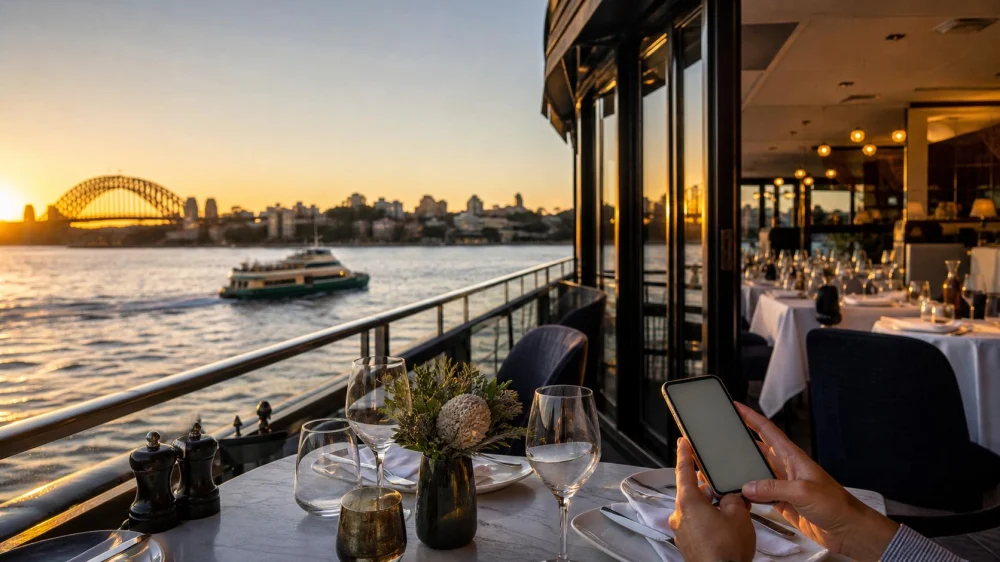
Sydney Waterfront Restaurant Booking Checklist: View, Weather, and Transport
On this page
- Quick answer
- Confirm what “waterfront” means
- Request the right table without assumptions
- Build a weather backup plan
- Prepare for sun, wind, and temperature
- Plan ferry and public transport timing
- Check the route and accessibility
- Confirm menu, timing, and costs
- Account for harbour events and crowds
- Reconfirm on the day
Quick answer
When booking a Sydney waterfront restaurant, confirm the exact location, whether the view is from your table or only part of the venue, indoor and outdoor seating options, weather relocation policy, direct walking route, nearest wharf or station, last practical trip home, accessibility, menu, minimum spend, surcharge, and cancellation terms. Treat a view request as a preference unless the restaurant guarantees it in writing.
Check the forecast and live transport information on the day. Allow time to find the entrance because a restaurant may face the harbour while its street access sits inside a hotel, wharf precinct, shopping complex, or lower promenade. Keep a backup route that does not depend on one ferry or exposed walkway.
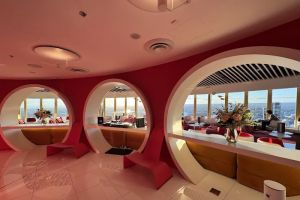
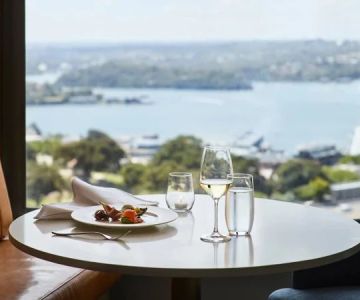
Bar 83 at Sydney Tower
SydneyCouncil of the City of SydneyNew South Wales
Westfield Sydney, Level 4/108 Market St, Sydney NSW 2000, Australia
Confirm what “waterfront” means
Ask whether the restaurant is directly on the harbour, river, beach, marina, or a building with a distant water view. Request current photos or a floor plan showing the dining rooms and terraces. A venue can accurately describe itself as waterfront even when many tables face inward.
Clarify what landmarks may be visible and at what time. Buildings, trees, boats, awnings, construction, cruise ships, low light, and table orientation can change the experience. Sunset direction and harbour lighting differ by location and season, so avoid assuming a particular photograph matches your booking.

Request the right table without assumptions
State the important feature: unobstructed view, indoor window, outdoor edge, shade, quiet corner, step-free access, space for a pram, or protection from wind. Ask whether the request can be guaranteed, carries a fee or minimum spend, or remains subject to availability.
Record the request in the reservation and confirmation email. Arrive on time, but understand that a preferred table may be occupied if the venue did not guarantee it. Decide before booking whether you would accept a different table or rather choose another date.
Build a weather backup plan
Ask whether outdoor tables are covered, enclosed, heated, cooled, or fully exposed and what happens during rain, wind, smoke, extreme heat, lightning, or unsafe conditions. Confirm whether the restaurant automatically moves guests indoors, cancels, offers a later time, or applies its standard cancellation policy.
An umbrella protects from light overhead rain but not necessarily wind-driven rain, glare, or water on the floor. If an indoor backup is essential, reserve one explicitly. Save the written weather policy and check how late you may switch plans without losing a deposit.
Prepare for sun, wind, and temperature
Ask which direction the terrace faces and whether shade covers the table at your booking time. Bring sun protection suitable for the season, but do not apply strong spray sunscreen at the table. A light layer can help after sunset because exposed waterfront areas may feel cooler than inland streets.
Secure hats, napkins, menus, and small belongings in wind. Tell staff about unstable umbrellas, wet surfaces, or loose objects instead of moving heavy equipment. Choose closed or secure footwear when the route includes wharves, steps, cobbles, or long waterfront walks.
Plan ferry and public transport timing
Identify the precise wharf, station, stop, and walking exit rather than searching only the suburb. Use the official Transport for NSW Trip Planner for real-time routes, departures, service updates, accessibility details, and fare estimates. Check again shortly before leaving.
Plan both arrival and return journeys. Note the final practical service, interchange time, wharf closure risk, and a backup train, light rail, bus, taxi, rideshare, or designated driver. Ferry services can be affected by disruptions, so review the official ferry travel alerts rather than relying on an old screenshot.
Check the route and accessibility
Ask for the step-free entrance, lift location, door widths, restroom access, table clearance, and drop-off point. A waterfront route may include steep ramps, gangways, stairs, uneven promenades, or lifts controlled by another building. The closest wharf is not always the easiest accessible route.
Transport for NSW notes that accessible journey planning should include both vessels and wharves; some older wharves have steps. Share the actual mobility aid, pram, vision, hearing, or fatigue needs with both the restaurant and transport operator and keep an alternative route.
Confirm menu, timing, and costs
Review the current menu for set-menu requirements, seafood market prices, dietary options, children’s meals, kitchen closing time, cake or corkage rules, and whether outdoor tables use a reduced menu. Ask how long the meal usually takes if transport or a performance follows.
Check deposits, cancellation windows, minimum spends, card surcharges, weekend or public-holiday surcharges, service charges, and table time limits. Request a sample total for groups and put special arrangements in writing.
Account for harbour events and crowds
Fireworks, festivals, races, concerts, cruise movements, road closures, and major sporting events can change access, prices, menus, seating duration, and views. Ask whether a special-event package or nonrefundable prepayment applies and whether normal transport routes will operate.
Allow extra walking and queue time and avoid planning a tight connection. Choose a meeting point away from the busiest entrance, share the reservation name, and download essential contact details in case mobile networks are congested.
Reconfirm on the day
Confirm the reservation, table area, weather plan, guest count, dietary notes, arrival window, address, entrance, and current menu. Check forecast, ferry alerts, Trip Planner, road conditions, and the return route. Charge phones and carry the restaurant number.
Leave enough time to enjoy the location without rushing. The best waterfront booking is not only the table with the strongest view; it is the one with clear expectations, a safe weather option, reliable transport, accessible routing, and costs understood before arrival.

 Gowings4.0 (1121 reviews)
 Madison Ave Coffee5.0 (1 reviews)
 Lüneburger German Bakery5.0 (5 reviews)
 Gözleme King Sydney4.0 (206 reviews)
 Esque4.0 (8 reviews)
 Guzman y Gomez - ICC Darling Harbour4.0 (770 reviews)
 The Best Late Evening Small Plates Restaurants in Melbourne’s CBD
 Where to Eat Authentic Finnish Food in Australia for Nordic Cuisine
 Where to Eat Authentic Laotian Food in Australia for Southeast Asian Cuisine
 Cheap Eats in Sydney Under $20 That Don’t Compromise on Taste
 How Gen Z Is Shaping Australia’s Restaurant Menu Trends
 The Best Sushi and Sashimi Restaurants in Perth for Premium Seafood Lovers